Home · How big?
The signature desk
How big was that hailstone?
Pick an official National Weather Service comparison name. The desk shows the diameter from the NWS glossary, a conversion into millimetres, and whether that size meets the U.S. severe-thunderstorm threshold of one inch. The same figures stay in the table below, so the desk is a clearer view of the record, not a different one.
Official NWS comparison names
Choose a size to see the official diameter and whether it counts as severe hail in the United States.
Diameters in inches are the official glossary figures. Millimetres are a conversion (1 inch = 25.4 mm) and are labelled as such. Some local offices prefer mothball or M&M instead of marble for half-inch hail, because marbles come in more than one size.
The official chart
From the National Weather Service glossary entry for hail size. [source] Severe hail, for U.S. warnings, starts at one inch. [source]
| Official name | Diameter | U.S. warning sense |
|---|---|---|
| Pea | 0.25 in (6.3 mm) | Below the U.S. severe threshold |
| Marble or mothball | 0.50 in (12.7 mm) | Below the U.S. severe threshold |
| Penny or dime | 0.75 in (19.0 mm) | Below the U.S. severe threshold |
| Nickel | 0.88 in (22.4 mm) | Below the U.S. severe threshold |
| Quarter | 1.00 in (25.4 mm) | Severe, in the official U.S. sense |
| Half dollar | 1.25 in (31.8 mm) | Severe, in the official U.S. sense |
| Walnut or ping-pong ball | 1.50 in (38.1 mm) | Severe, in the official U.S. sense |
| Golf ball | 1.75 in (44.4 mm) | Severe, in the official U.S. sense |
| Hen's egg | 2.00 in (50.8 mm) | Severe, in the official U.S. sense |
| Tennis ball | 2.50 in (63.5 mm) | Severe, in the official U.S. sense |
| Baseball | 2.75 in (69.8 mm) | Severe, in the official U.S. sense |
| Tea cup | 3.00 in (76.2 mm) | Severe, in the official U.S. sense |
| Grapefruit | 4.00 in (101.6 mm) | Severe, in the official U.S. sense |
| Softball | 4.50 in (114.3 mm) | Severe, in the official U.S. sense |
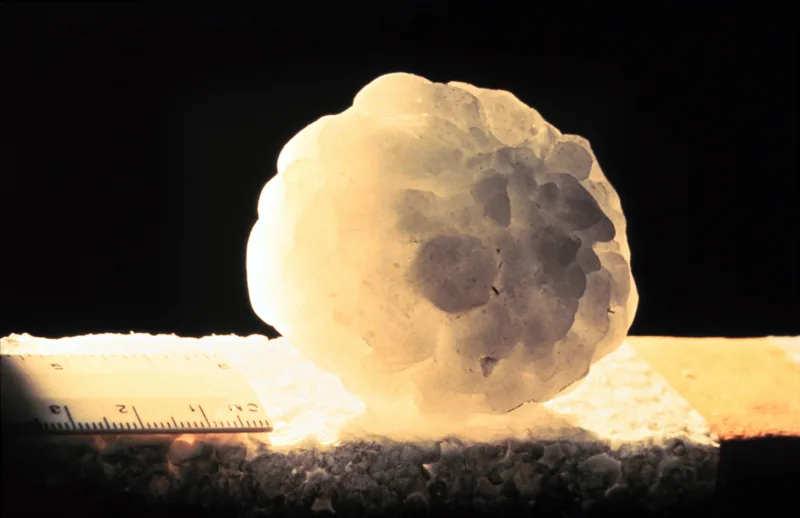
Stones larger than a softball do occur. They are just not given everyday comparison names in the glossary. The United States record diameter is 8.0 inches, from Vivian, South Dakota, on 23 July 2010. The record stones have their own page.